A practical guide by Richard Harvie
Start from Scratch, Plan from the End
How to build a sustainability strategy
From a blank page: carbon footprint, net zero plan and climate risk, with ready-to-use templates. Asked to lead on sustainability, with no team, no budget and no obvious place to start? This book gives you a plan you can follow, one step at a time.
Out on Amazon in early 2027 in paperback, followed by hardback and Kindle editions.
Written for the person who has just been handed the job
Most books on sustainability explain the problem. This one shows you what to do on Monday morning, and how to keep going once the early enthusiasm fades.
Sustainability officers and leads
New in post, or the first person ever to hold the role. Start with your first week, a 90-day plan and a carbon baseline, then build a strategy your leadership team will sign off.
Managers with sustainability added to the day job
You already have a full job. The templates give you a head start on every document, and the AI prompts take on the number work, with guidance on checking the results.
Leaders, sponsors and trustees
A section written for sponsors and leadership teams sets out what to ask for, what to fund and what good progress looks like, so you can back the work properly.
Public sector, business or charity: the method works in any organisation, and there are shorter routes through the book for small businesses, schools and small charities. The examples are drawn from published sources or are composites of common situations, and the book is written from a UK point of view.
Three tasks and one idea
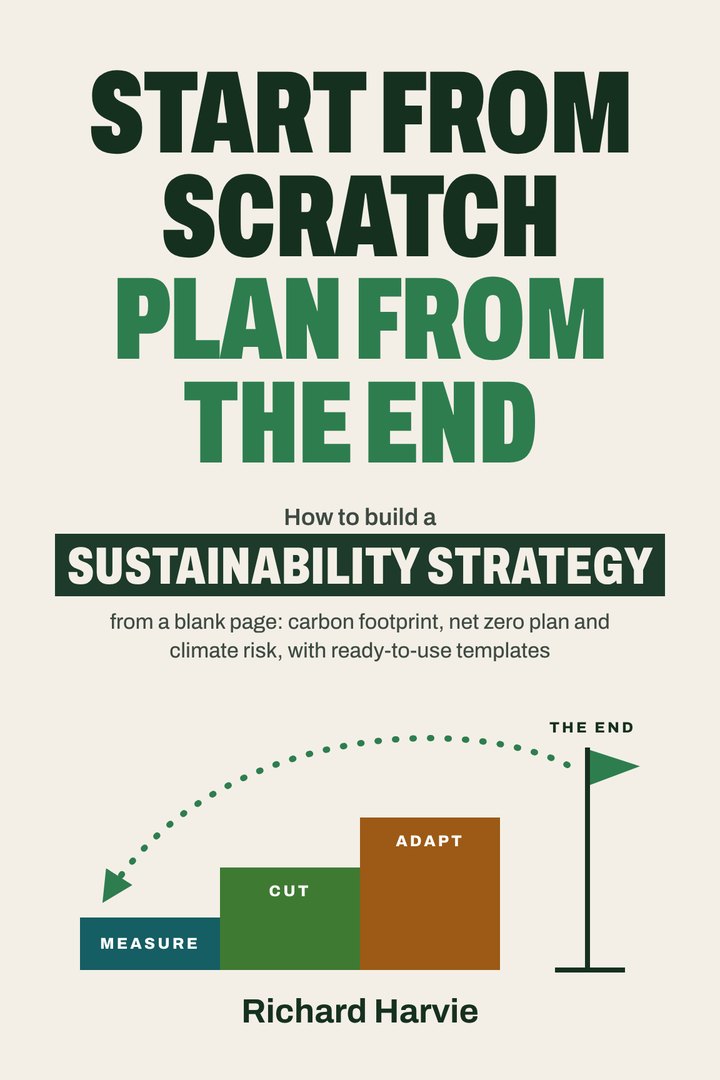
The book is built around three tasks, Measure, Cut and Adapt, and one idea: plan from the end. Most organisations set a target and hope to reach it. This book starts with a clear picture of success and works backwards to what you need to do this year.
Measure
Find out where you are. Turn your energy, fuel, travel, waste and what you buy into a carbon footprint you can repeat every year. Without that starting point, every target is a guess.
Cut
Use the numbers to find the biggest sources and the quickest wins, then plan the larger changes to transport, buildings, energy and what you buy over time.
Adapt
Heatwaves, floods and storms are already affecting buildings, services and supply chains. Preparing for them is as much a part of the job as cutting emissions, and far more often forgotten.
Sixteen chapters in six parts
Read it in order, or go straight to the chapter you need this week. A worked example follows one fictional organisation, Fallowmere Services, from its new lead's first week to a funded action plan and beyond.
-
Part 1Understand
Why sustainable change matters now, the framework in plain English, and why every organisation needs both to cut its emissions and to adapt.
- 1Why sustainable change matters now
- 2The Natural Step in plain English
- 3Cutting emissions and adapting
-
Part 2Measure
Getting started with no team or budget, measuring your carbon footprint, using AI for the number work, and reporting in a way you can repeat.
- 4Starting from nothing
- 5Measuring your carbon
- 6Let AI do the number work
- 7Reporting you can repeat
-
Part 3Plan from the end
Turning your picture of success into a vision and targets you can realistically hit.
- 8A vision and targets you can hit
-
Part 4Cut and adapt
The action plan: transport, buildings and energy, what you buy, climate risks, and paying for it all.
- 9The action plan
- 10Adapting to a changing climate
- 11Paying for it
-
Part 5Keep going
Bringing people with you, working with partners, and keeping momentum once the early enthusiasm fades.
- 12People and culture
- 13Working with partners
- 14Lessons learned and keeping momentum
-
Part 6Going further
Beyond the first two years: measuring and cutting the emissions in your supply chain, and widening the lens from carbon to nature, water and people.
- 15Your supply chain
- 16Beyond carbon
The book closes with ten lessons and a final word.
A checklist at the end of every chapter
Plain-English guides to net zero, carbon accounting and the current UK rules
24 templates and 11 ready-to-use AI prompts
A section for sponsors and leadership teams
Honest answers to the awkward questions every lead gets asked
A glossary and suggestions for further reading
24 templates, free to download
Every template from the book as a Word file you can edit, a carbon baseline workbook that adds up for you, and the 11 AI prompts. Each one is matched to the chapter that explains how to use it.
- A.24
Your first week
Five things to do in your first week, none of which needs a budget
- A.1
Carbon baseline
Measures where you are today, as an Excel workbook with the 2026 factors built in
- A.7
Carbon Reduction Plan
Answers what customers and public sector buyers ask for
- A.12
Strategy on a page
Sums up the strategy on one side of A4, for the people who will read nothing else
- A.3
Climate risk assessment
Shows which climate risks matter and what you will do about them
Plus the terms of reference, data request, 90-day plan, annual report, business case, funding plan, briefing note, launch pack, handover pack and more. Enter your email address on the next page and the download links appear straight away.
Work out a first carbon baseline
Enter a year of figures from your bills and records. The calculator uses the UK Government's 2026 conversion factors, the same ones used in Chapter 5. Nothing you type leaves your browser.
Factors: UK Government greenhouse gas conversion factors 2026, published by the Department for Energy Security and Net Zero (GOV.UK). Gas uses the gross calorific value factor that most bills are based on, fuels use the average biofuel blend, and electricity is location-based.
Scope 3 here covers only a few common sources. What you buy is often the largest part of an organisation's footprint, and Chapter 15 shows how to estimate it. The baseline workbook in the free templates adds heating oil and LPG, and room for your own sources.
Factors change every year, so report your energy use (kWh and litres) alongside your emissions. It shows whether you are really using less or the factor has simply moved.
A target without a plan is a New Year's resolution.
From Chapter 8
About the author

Richard Harvie has been turning over the same question since college: could The Natural Step, a framework born in Sweden, help ordinary British organisations change for good?
He carried it to the University of Brighton, where it became his 2012 dissertation. The dissertation won an award, and he was invited back for doctoral research and teaching, but he chose the world of work instead. He founded a driving school and grew it through franchising, teaching drivers to save fuel and later to get the best from electric cars. Again and again, he watched small, practical changes add up across a whole organisation.
Today he leads on sustainability in the UK public sector, and he has done what this book describes: started a strategy from scratch, built on the good work colleagues had already begun, measured the footprint and planned back from the end. He wrote it for the person who has just been handed the job and is wondering where to start, which is where he once stood.
- Studied
- Business Management, specialising in Sustainability, at the University of Brighton
- Dissertation
- Is The Natural Step a viable approach for British enterprise? (2012), which won an award
- Founded
- A driving school, grown through a franchise model, with fleet, eco-driving and electric vehicle training
- Now
- Leads on sustainability in the UK public sector
- Believes
- Sustainable change should be practical, measurable and explained in plain English
Out in early 2027
In paperback on Amazon first, then in hardback and on Kindle. Get the templates now, and tick the box to hear the day each edition is out.